
VA Loan Closing Costs and Fees: What Veterans Should Know
Published on Apr 02, 2024 | VA Loans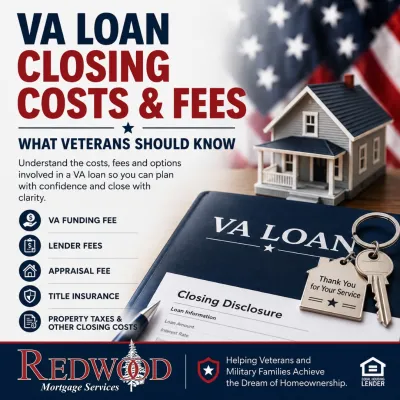
VA loans offer significant home financing benefits for eligible veterans, active-duty service members and certain surviving spouses. Many eligible borrowers can purchase a home without a required down payment, and VA loans don't require monthly private mortgage insurance.
However, a VA loan isn't necessarily a no-cost loan.
Like other mortgages, VA-backed loans can involve closing costs, prepaid expenses and other charges. There may also be a VA funding fee, depending on the borrower's circumstances.
Understanding these expenses before making an offer can help you better estimate how much cash you may need at closing.
If you're considering a VA loan in Annapolis, Anne Arundel County or elsewhere in Maryland, here's what you should know about VA loan closing costs and fees.
What Closing Costs Can You Have With a VA Loan?
Closing costs vary from one VA loan transaction to another. According to the Department of Veterans Affairs, costs associated with a VA purchase may include items such as:
- Loan origination charges
- Discount points, when applicable
- Credit report charges
- VA appraisal fee
- Hazard insurance
- Real estate taxes
- State and local taxes
- Title insurance
- Recording fees
The actual costs will depend on factors such as the loan amount, property location, lender and individual transaction.
Your Loan Estimate provides an important early breakdown of the estimated costs associated with your mortgage.
What Is the VA Funding Fee?
The VA funding fee is a one-time charge that applies to many VA-backed and VA direct home loans.
The fee helps reduce the cost of the VA home loan program to taxpayers because the program generally doesn't require a down payment or monthly mortgage insurance.
The amount of the funding fee can depend on factors including:
- The type of VA loan
- The loan amount
- Whether you've previously used your VA home loan benefit
- The amount of your down payment for certain loan types
For VA-backed purchase and construction loans, current funding-fee percentages range from 1.25% to 3.3%, depending on the borrower's circumstances.
Because VA funding-fee amounts can change, borrowers should check the current VA funding-fee schedule when evaluating a transaction.
Are Some Veterans Exempt From the VA Funding Fee?
Yes. Not every eligible VA borrower has to pay the funding fee.
VA identifies several circumstances in which a borrower may qualify for an exemption. These include certain veterans receiving—or eligible to receive—VA compensation for a service-connected disability, certain surviving spouses receiving Dependency and Indemnity Compensation, and certain active-duty Purple Heart recipients.
There are additional circumstances that can qualify, so borrowers should have their individual funding-fee status verified rather than assuming the fee applies.
Can You Finance the VA Funding Fee?
Yes. The VA funding fee can generally either be:
- Paid in full at closing, or
- Financed into the VA loan
Financing the funding fee reduces the amount of cash needed at closing but increases the amount borrowed.
This is an important distinction from most other closing costs on a VA purchase loan.
Can You Finance Other VA Closing Costs?
Generally, not on a VA purchase or construction-to-permanent loan.
VA states that the funding fee is the closing cost that can be financed into the loan amount on these transactions. Other applicable fees and charges generally must be paid at closing.
However, that doesn't necessarily mean the veteran must personally pay every closing cost.
Depending on the transaction, the seller, lender or another party may be able to pay certain allowable costs.
Can the Seller Pay a Veteran's Closing Costs?
Yes. VA rules allow sellers or builders to provide credits toward some or all of a buyer's closing costs.
This is where an important distinction needs to be made between ordinary closing costs and what VA specifically defines as seller concessions.
VA's 4% limitation applies to seller concessions—not simply to every closing cost a seller may pay.
Examples of items that may be considered seller concessions include:
- Payment of the buyer's VA funding fee
- Prepayment of certain property taxes and insurance
- Certain temporary or permanent interest-rate buydowns
- Payment of certain credit balances or judgments on behalf of the buyer
How costs and concessions are structured should be reviewed as part of the specific purchase transaction.
What Is the VA Appraisal Fee?
A VA-backed purchase generally requires a VA appraisal.
The appraisal helps determine the property's reasonable value and whether the property meets applicable VA requirements. It should not be confused with a home inspection.
VA appraisal fees vary by location and property type. Because these fees can vary, borrowers should review the current VA appraisal fee schedule for their location and property type.
Is a VA Appraisal the Same as a Home Inspection?
No.
A VA appraisal and an independent home inspection serve different purposes.
The VA appraisal is part of the VA loan process. A home inspection is a separate evaluation of the property's condition that a buyer may choose to obtain.
VA itself recommends that buyers consider a professional home inspection and specifically notes that the VA appraisal doesn't take the place of an inspection.
What About Property Taxes and Homeowners Insurance?
Some of the money needed at closing may not technically represent a lender fee.
Borrowers may also need funds for items such as homeowners insurance, property taxes and amounts placed into an escrow account for future payments.
These are sometimes referred to as prepaid items or initial escrow deposits.
The amount needed can vary significantly depending on the property, closing date, insurance costs and local property taxes.
How Will You Know Your Actual VA Closing Costs?
Your lender will provide a Loan Estimate showing estimated loan terms and closing costs.
Before closing, you'll also receive a Closing Disclosure, which provides the final loan terms and closing-cost information. VA notes that the Closing Disclosure must generally be provided at least three business days before closing.
Review these documents carefully and ask questions about any fee or charge you don't understand.
How Much Cash Do You Need to Close a VA Loan?
There isn't one standard dollar amount that applies to every VA borrower.
The amount of cash needed can depend on:
- Purchase price and loan amount
- Whether you're making a down payment
- VA funding-fee status
- Closing costs
- Prepaid taxes and insurance
- Initial escrow requirements
- Seller-paid costs or concessions
- Lender credits, when applicable
- Earnest money or other credits already paid
One of the benefits of getting pre-approved early is that your mortgage professional can help you estimate these costs before you begin making offers.
Explore Your VA Loan Options
Understanding closing costs is an important part of preparing for a VA home purchase.
Redwood Mortgage Services can help eligible veterans and military families review their VA financing options and better understand the potential costs associated with a particular transaction.
For a broader overview of VA eligibility, entitlement, purchase and refinance options, visit our VA Home Loans in Annapolis, MD page.
All loans subject to approval. Equal Housing Lender.
Frequently Asked Questions
Do VA loans have closing costs?
Yes. VA loans can include closing costs such as lender charges, appraisal fees, title-related costs, recording fees, taxes and other expenses associated with the transaction. The exact costs vary by loan and property.
Can a seller pay closing costs on a VA loan?
Yes. A seller may pay certain allowable closing costs for a VA buyer. VA also permits certain seller concessions, although specific rules and limits apply to how those concessions are structured.
Is the VA funding fee considered a closing cost?
The VA funding fee is a one-time charge associated with many VA loans. Unlike most closing costs on a VA purchase loan, the funding fee can generally be financed into the loan rather than paid entirely at closing. Some eligible borrowers are exempt from the funding fee.
Do VA loans require a home inspection?
VA does not require a home inspection simply because you're using a VA loan. A VA appraisal is generally required for a VA-backed purchase, but an appraisal is not a substitute for an independent home inspection.
Can you buy a home with a VA loan and bring no money to closing?
It's possible for some VA borrowers to have relatively little cash due at closing, but zero down payment does not automatically mean zero cash needed at closing. Closing costs, prepaid expenses, escrow deposits and the structure of the transaction all affect the amount required.
Related Reading
How to Qualify for a VA Loan in 2026: Eligibility, Requirements & Pre-Approval
Learn how VA eligibility, credit, income, residual income, entitlement and pre-approval work when preparing to purchase a home with VA financing.
5 Common VA Loan Myths Veterans in Anne Arundel County Should Know
Get the facts about common VA loan misconceptions involving down payments, credit, sellers, entitlement and the VA appraisal process.
How Much Are Closing Costs in Maryland?
Learn more about the broader closing costs Maryland homebuyers may encounter and the factors that can affect the amount needed at closing.
Written by Charles Stuart Kiehne, President of Redwood Mortgage Services.
Stuart has helped homebuyers and homeowners with mortgage financing solutions since 1999 and is licensed in Maryland, Virginia, Washington DC, Delaware, North Carolina, and Florida.
NMLS #92008