
Top 10 Tips for Choosing a VA Lender in Annapolis MD
Published on Apr 23, 2026 | Mortgage Advice VA Loans #RedwoodMortgageServices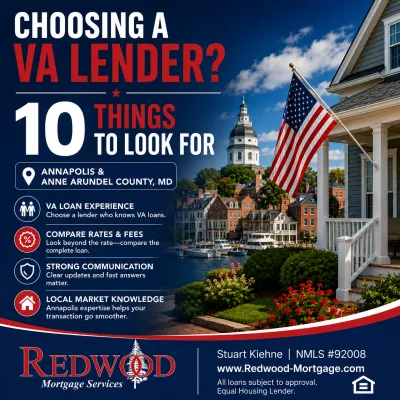
Quick Answer: When choosing a VA lender in Annapolis, Maryland, compare VA loan experience, interest rates, fees, underwriting knowledge, communication, and familiarity with the local housing market. An experienced lender should explain your eligibility, entitlement, appraisal requirements, and financing options before you commit to a loan.
For eligible Veterans, active-duty service members and surviving spouses, the VA home loan benefit can provide valuable financing options when purchasing or refinancing a home.
But the U.S. Department of Veterans Affairs generally isn't the lender making your VA-backed mortgage. VA-backed loans are provided through private lenders, and rates, fees, underwriting processes, communication and VA experience can differ from one lender to another. The VA itself encourages borrowers to compare lenders when considering their options.
If you're buying a home in Annapolis, Anne Arundel County or elsewhere in Maryland, choosing a lender that understands both VA financing and the local real estate market can make an important difference in your experience.
Here are 10 things to consider when choosing a VA lender.
1. Look for Significant VA Loan Experience
VA loans have requirements and procedures that differ from conventional financing. Your lender should understand VA eligibility, Certificates of Eligibility (COEs), entitlement, funding fees, appraisals, Minimum Property Requirements and allowable fees and closing costs.
Ask prospective lenders how frequently they work with VA borrowers and how familiar their loan team is with VA guidelines.
Experience can become particularly important when a transaction involves issues such as remaining entitlement, a previous VA loan, an appraisal concern or an unusual property situation.
If you've heard conflicting information about VA financing, you may also want to read our guide to common VA loan myths.
2. Compare More Than the Interest Rate
Don't choose a VA lender based solely on an advertised interest rate.
The VA does not set the interest rate on a VA-backed mortgage. Individual lenders establish their rates and fees, which means offers can vary from lender to lender. VA itself recommends comparing lenders.
When evaluating an offer, consider the interest rate along with:
- APR
- Discount points
- Lender fees
- Estimated closing costs
- Loan term
- Overall loan structure
A lower advertised rate doesn't necessarily mean a particular loan offer will be the best fit for you.
For a deeper explanation, see How to Get a Better VA Loan Rate: What Veterans Should Know.
3. Make Sure the Lender Understands VA's No-Mortgage-Insurance Benefit
VA-backed purchase loans don't require monthly private mortgage insurance (PMI) or FHA-style mortgage insurance premiums (MIP).
That's an important distinction when comparing VA financing with other low-down-payment mortgage options.
Rather than comparing loans based solely on their interest rates, ask your lender to help you understand the overall monthly housing payment and total loan costs.
4. Understand When a VA Loan May Require a Down Payment
VA financing is well known for its no-down-payment benefit. In fact, VA reports that nearly 90% of VA-backed loans are made without a down payment.
However, that doesn't mean every VA transaction will automatically require zero down.
Entitlement, purchase price, appraised value and the borrower's overall financing situation can affect how a particular transaction is structured.
A knowledgeable VA lender should review your Certificate of Eligibility and entitlement early in the process rather than simply assuming the transaction will be zero-down.
5. Ask How the Lender Manages VA Appraisals and Potential Issues
Don't choose a lender because someone promises that every VA loan will close within a certain number of days.
Instead, ask about the lender's process.
How quickly can documentation be reviewed? Who monitors the VA appraisal? How will you and your real estate agent be notified if an issue arises? Who is available to answer questions during the transaction?
VA financing doesn't inherently mean a difficult transaction, but good communication and familiarity with VA requirements can be particularly valuable when deadlines matter.
Sellers and real estate agents sometimes have outdated perceptions about VA financing. Our article VA Loan Offers: What Home Sellers Really Need to Know explains several of the issues sellers may encounter when evaluating a VA-financed offer.
6. Ask About the Lender's Credit Requirements
The VA does not establish a universal minimum credit score for its home loan guaranty program. However, individual lenders can establish their own credit requirements.
That's an important distinction.
If one lender tells you that you don't qualify because of a particular credit score, that doesn't necessarily mean the VA itself has denied your eligibility.
At the same time, VA eligibility doesn't guarantee loan approval. Lenders still evaluate factors such as credit history, income, debts and assets when determining whether a borrower qualifies.
7. Make Sure the Lender Understands VA's Residual-Income Analysis
Debt-to-income ratio is important, but it isn't the only consideration in VA underwriting.
An experienced VA lender should understand how the borrower's complete financial profile is evaluated and be able to explain how income, debts, credit history and other qualifying factors affect the application.
This is particularly important because VA underwriting isn't simply a matter of finding a maximum DTI and determining how large a loan a borrower can obtain.
A good lender should help you understand what payment and loan structure make sense based on both program requirements and your financial circumstances.
8. Understand the VA Funding Fee and Possible Exemptions
Many VA borrowers pay a one-time VA funding fee. The amount isn't the same for everyone.
It can vary depending on factors such as the type of VA loan, the size of the down payment and whether the borrower has previously used the VA home loan benefit. Certain eligible Veterans, service members and surviving spouses may be exempt from paying the funding fee.
Your lender should determine your funding-fee status and explain how the fee affects your particular transaction.
For a more detailed explanation of VA expenses, read VA Loan Closing Costs and Fees: What Veterans Should Know.
9. Consider Local Annapolis and Anne Arundel County Experience
VA guidelines apply nationwide, but real estate transactions are local.
A lender familiar with Annapolis and Anne Arundel County may already understand the local real estate community, settlement practices, property types and issues that commonly arise during transactions in the area.
Local knowledge can also be useful when your lender needs to communicate with your real estate agent, listing agent, settlement company or other professionals involved in the transaction.
For military buyers relocating to the Annapolis area, having a lending team familiar with the local market can provide an additional layer of practical guidance.
At Redwood Mortgage Services, President Stuart Kiehne (NMLS #92008) has helped homebuyers and homeowners with mortgage financing since 1999. His experience serving Annapolis, Anne Arundel County, and surrounding Maryland communities allows him to help borrowers evaluate their VA financing options and communicate with the professionals involved in their home purchase.
10. Pay Attention to Communication Before You Choose
You don't have to wait until you're under contract to find out how well a lender communicates.
Pay attention during the pre-approval process.
Does the lender explain things clearly? Do you know who to contact with questions? Are documents reviewed carefully? Does the lender communicate with your real estate agent when appropriate? Do you understand the numbers before moving forward?
A mortgage transaction involves the borrower, lender, real estate agents, appraiser, settlement professionals and others. Clear communication among those parties can help keep everyone informed throughout the process.
The Bottom Line
Choosing a VA lender shouldn't be about finding the lender with the biggest promises or simply selecting the lowest advertised rate.
Look for a lender that understands VA financing, explains your options clearly, provides transparent information about rates and fees, carefully reviews your qualifications and communicates throughout the transaction.
For buyers in Annapolis and Anne Arundel County, experience with both VA lending and the local real estate market can be particularly valuable.
Redwood Mortgage Services has worked with homebuyers and homeowners since 1999 and provides VA mortgage financing in Maryland, Virginia, Washington, DC, Delaware, North Carolina and Florida.
You can also explore our VA Home Loans in Annapolis, MD resource for more information about VA eligibility, benefits and the homebuying process.
Have questions about choosing a VA lender in Annapolis?
Speak directly with Stuart Kiehne at Redwood Mortgage Services about your VA eligibility, financing options, and next steps. Whether you're purchasing your first home, relocating to Maryland, or using your VA home loan benefit again, a conversation can help you understand your options.
Schedule a Consultation or Start Your Loan Application.
Frequently Asked Questions
What should I look for in a VA lender?
Consider the lender's experience with VA loans, communication, credit requirements, fees, knowledge of VA appraisal and underwriting procedures, and ability to explain your financing options clearly. Because lenders can offer different rates and fees, VA recommends comparing lenders before choosing one.
Are all VA lenders the same?
No. Although VA establishes requirements for the VA home loan guaranty program, borrowers obtain VA-backed mortgages from private lenders. Rates, fees, lender requirements, service and experience can vary.
Does the VA require a minimum credit score?
The VA does not establish a minimum credit score for the VA home loan guaranty program, but individual lenders may have their own credit requirements.
Does a VA loan always require no down payment?
No down payment is required in many VA purchase transactions, and VA reports that nearly 90% of VA-backed loans are made without one. However, the circumstances of the individual transaction, including entitlement and the relationship between purchase price and appraised value, can affect the amount a borrower needs to bring to closing.
Do VA loans require monthly mortgage insurance?
No. VA-backed purchase loans don't require monthly PMI or MIP. A VA funding fee may apply, although some eligible borrowers are exempt.
Why might local VA lending experience matter in Annapolis?
The VA program is national, but the home purchase itself involves local real estate practices, agents, settlement professionals and properties. A lender familiar with Annapolis and Anne Arundel County may be better positioned to coordinate with the local professionals involved in the transaction.
Related Reading
How to Qualify for a VA Loan in 2026: Eligibility, Requirements & Pre-Approval
Learn about VA eligibility, Certificates of Eligibility, credit, income and the pre-approval process.
VA Loan Offers: What Home Sellers Really Need to Know
Understand VA appraisals, seller-paid costs and common misconceptions that can affect VA-financed offers.
VA Loan Closing Costs and Fees: What Veterans Should Know
Learn which expenses may accompany a VA loan, how the funding fee works and which costs sellers may be permitted to pay.
How to Get a Better VA Loan Rate: What Veterans Should Know
Learn what can influence VA mortgage pricing and why comparing the complete loan—not just the advertised interest rate—is important.
Written by Charles Stuart Kiehne, President of Redwood Mortgage Services
Stuart Kiehne has helped homebuyers and homeowners with mortgage financing solutions since 1999.
Stuart Kiehne | NMLS #92008
Redwood Mortgage Services | NMLS #91893
www.Redwood-Mortgage.com
410-266-1641
All loans subject to approval. Equal Housing Lender.