


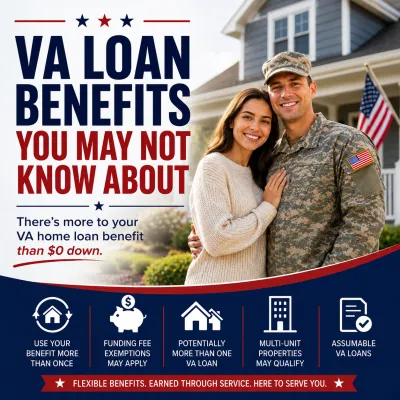
Most veterans and active-duty service members who are familiar with VA home loans know about two of the program's best-known advantages: eligible borrowers may be able to purchase a home without a required down payment, and VA loans don't require monthly private mortgage insurance.
But those aren't the only features of VA financing worth understanding.
The VA home loan program includes several lesser-known benefits and options that can become particularly important when buying another home, relocating, purchasing a multi-unit property, refinancing or planning for future housing needs.
Some benefits are available only in specific circumstances, and VA eligibility doesn't automatically mean every borrower or transaction will qualify. Still, understanding these options can help veterans make better use of the home loan benefits they've earned.
If you're considering VA financing in Annapolis, Anne Arundel County or elsewhere in Maryland, here are some VA loan benefits you may not know about.
1. Your VA Home Loan Benefit Can Be Used More Than Once
One of the biggest misconceptions about VA financing is that the benefit is available only once.
It isn't.
Eligible veterans and service members may potentially use their VA home loan benefit multiple times throughout their lives.
Previously used entitlement may be restored in certain circumstances, and some veterans may have remaining entitlement available even while another VA-backed mortgage is outstanding.
The amount of entitlement available and whether a down payment could be required depend on the individual situation.
For a complete explanation, read How Many Times Can You Use a VA Loan? Understanding VA Entitlement
2. Some Veterans Are Exempt From the VA Funding Fee
Many VA-backed loans include a one-time VA funding fee.
However, not every eligible borrower has to pay it.
VA provides funding-fee exemptions for certain borrowers, including some veterans receiving—or eligible to receive—VA compensation for a service-connected disability, certain surviving spouses receiving Dependency and Indemnity Compensation, and certain active-duty service members who have received the Purple Heart.
Because funding-fee status can materially affect the cost of a VA loan, eligible borrowers should have their exemption status verified as part of the mortgage process.
For more information about the funding fee and other costs associated with VA financing, read VA Loan Closing Costs and Fees: What Veterans Should Know
3. You May Be Able to Have More Than One VA Loan at the Same Time
Having an existing VA-backed mortgage doesn't necessarily prevent an eligible veteran from obtaining another VA loan.
This can be especially important for military families who relocate.
For example, a service member receiving permanent change of station orders may want to keep a home purchased with VA financing while purchasing another primary residence near the new duty station.
Whether that's possible depends in part on how much VA entitlement remains available, the proposed purchase and the borrower's ability to qualify for the new mortgage.
This is another reason veterans who have previously used VA financing should review their Certificate of Eligibility and available entitlement before assuming they've already used their benefit.
4. VA Loans May Be Used to Purchase Certain Multi-Unit Properties
VA financing isn't necessarily limited to a traditional single-family home.
An eligible borrower may potentially use VA financing to purchase certain properties containing multiple residential units, provided applicable VA requirements are satisfied.
This can create an interesting opportunity for a veteran who wants to purchase a property, occupy one unit as their home and have additional residential units on the property.
The important distinction is occupancy. A VA purchase loan isn't intended simply to finance an investment property that the eligible borrower doesn't plan to occupy as required.
Property eligibility, appraisal requirements, rental-income treatment and underwriting should all be reviewed before assuming a particular multi-unit property will qualify.
5. VA Loans Are Assumable
VA-backed mortgages can be assumed by another qualified borrower when applicable VA and servicer requirements are met.
An assumption allows another borrower to take over the existing VA loan rather than obtaining an entirely new mortgage.
This feature can become particularly interesting when an existing VA mortgage has terms that may be attractive compared with financing available when the property is sold.
However, veterans need to understand an important issue: an assumption doesn't automatically restore the original veteran's VA entitlement.
How the assumption is structured and whether an eligible veteran substitutes their entitlement can affect the seller's future VA home loan benefit.
Veterans considering an assumption should understand the entitlement consequences before completing the transaction.
6. VA Occupancy Rules Have More Flexibility Than Some Borrowers Realize
VA home loans are designed primarily to finance a borrower's residence, but the occupancy rules are sometimes misunderstood.
For a VA purchase loan, the eligible borrower generally must intend to occupy the property as their home within the period required by VA.
However, military life can create circumstances involving deployment, retirement, permanent change of station orders and other situations that don't fit neatly into a conventional homeownership timeline.
Occupancy requirements can also differ depending on the type of VA transaction.
For example, the occupancy standard for a VA Interest Rate Reduction Refinance Loan can differ from the requirement for a new VA purchase.
Read VA Loan Occupancy Requirements: What Veterans Need to Know for a more complete explanation:
7. VA Streamline Refinancing May Be Available to Existing VA Borrowers
Veterans who already have a VA-backed mortgage may have access to a refinance option specifically designed for existing VA loans.
The Interest Rate Reduction Refinance Loan (IRRRL) is commonly called a VA Streamline Refinance.
An IRRRL is a VA-to-VA refinance. It may potentially be used when an eligible borrower wants to refinance an existing VA-backed mortgage and the transaction satisfies applicable VA requirements.
An IRRRL isn't automatically beneficial simply because a lower interest rate is available. Closing costs, the new loan balance, loan term and the amount of time the homeowner expects to keep the mortgage should also be considered.
Read our complete guide, VA IRRRL: How a VA Streamline Refinance Works
8. Eligible Veterans With Certain Disabilities May Have Access to Housing Grants
Some veterans and service members with qualifying service-connected disabilities may be eligible for VA housing grants designed to help them purchase, build or modify an accessible home.
Two important programs are the Specially Adapted Housing (SAH) grant and the Special Home Adaptation (SHA) grant.
These aren't mortgage loans. They are separate VA benefits with their own eligibility requirements.
Depending on the program and circumstances, grant funds may help an eligible veteran or service member build an adapted home, modify an existing home or purchase a home that will be adapted.
Veterans considering both an adapted housing grant and mortgage financing should understand how the two pieces may work together.
Read VA Housing Grants for Veterans With Disabilities: SAH, SHA & Home Adaptations
9. A VA Loan May Be Used With Certain Co-Borrower Arrangements
VA financing isn't limited to a veteran purchasing alone or with a spouse.
Joint VA loans can potentially allow an eligible veteran to purchase a property with another veteran or, in certain circumstances, a non-spouse co-borrower.
These transactions can be considerably more complicated because the VA guaranty, entitlement, ownership interests and potential down-payment requirements can depend on who the borrowers are and which borrowers are using VA entitlement.
A veteran purchasing with a non-veteran spouse is also treated differently from a true joint VA loan involving an unrelated non-veteran co-borrower.
Read Joint VA Loans: Buying a Home With a Co-Borrower
10. VA Loans Aren't Just for First-Time Homebuyers
You don't have to be a first-time homebuyer to use a VA home loan.
An eligible veteran may use VA financing for a first home and potentially use the benefit again for future qualifying purchases.
That makes VA financing relevant during many different stages of life—whether you're purchasing your first property, moving because of military service, buying a larger home, downsizing later in life or relocating to another state.
The key is understanding your current eligibility, available entitlement, occupancy plans and overall qualification rather than assuming a previous home purchase disqualifies you.
Understanding the Full Value of Your VA Home Loan Benefit
The VA home loan program offers considerably more than a potential zero-down-payment mortgage.
For eligible veterans and service members, features such as reusable entitlement, funding-fee exemptions, loan assumptions, multi-unit financing, streamline refinancing and specialized housing benefits can provide flexibility at different stages of homeownership.
Not every benefit applies to every borrower, and some VA transactions require more detailed analysis than others.
If you've previously used a VA loan—or you're simply unsure what benefits may still be available—reviewing your Certificate of Eligibility and current circumstances can be a useful first step.
Explore Your VA Home Loan Options
Redwood Mortgage Services can help eligible veterans and military families review their VA home loan eligibility, entitlement and potential financing options.
For a broader overview of VA purchase loans, refinancing, eligibility and entitlement, visit our VA Home Loans in Annapolis, MD page.
All loans subject to approval. Equal Housing Lender.
Frequently Asked Questions
What are some VA loan benefits veterans may not know about?
Beyond the potential for no required down payment and no monthly private mortgage insurance, VA financing includes other features that eligible borrowers may find useful. These can include reusable entitlement, certain funding-fee exemptions, assumable loans, financing for certain multi-unit properties, VA streamline refinancing and specialized housing benefits for some veterans with service-connected disabilities.
Can you use your VA home loan benefit more than once?
Yes. Eligible veterans and service members may potentially use their VA home loan benefit multiple times. Previously used entitlement may be restored in certain circumstances, and some borrowers may have remaining entitlement available for another VA-backed mortgage.
Can you have two VA loans at the same time?
Potentially. An eligible veteran with an existing VA-backed mortgage may have remaining entitlement available for another VA loan. The amount of entitlement available, occupancy requirements, qualification and the details of the proposed transaction all matter.
Are some veterans exempt from the VA funding fee?
Yes. Certain eligible borrowers may be exempt from the VA funding fee, including some veterans receiving or eligible to receive VA compensation for a service-connected disability, certain surviving spouses receiving Dependency and Indemnity Compensation, and certain active-duty service members who have received the Purple Heart.
Can you buy a multi-unit property with a VA loan?
Potentially. Eligible borrowers may be able to use VA financing for certain multi-unit residential properties when applicable VA property and occupancy requirements are satisfied. A VA purchase loan isn't intended simply to finance an investment property the eligible borrower doesn't plan to occupy as required.
Can someone assume an existing VA loan?
VA-backed mortgages are generally assumable when applicable VA and servicer requirements are met. Veterans considering an assumption should also understand how it could affect their VA entitlement, because an assumption doesn't automatically restore the original veteran's entitlement.
Are VA loans only for first-time homebuyers?
No. VA home loan benefits aren't limited to first-time buyers. Eligible veterans and service members may potentially use VA financing for subsequent qualifying home purchases as well.
Related Reading
VA Loan Eligibility, Requirements & Pre-Approval
Learn how VA eligibility, Certificates of Eligibility, entitlement, income, credit and other requirements can affect qualification for a VA-backed home loan.
5 Common VA Loan Myths Veterans Should Know
Separate fact from fiction about VA financing, including misconceptions involving down payments, credit requirements, sellers, entitlement and the VA appraisal process.
How to Get a Better VA Loan Rate
Learn about factors that can affect a VA mortgage rate and why veterans should consider the overall loan costs and terms—not simply the advertised interest rate.
Written by Charles Stuart Kiehne, President of Redwood Mortgage Services.
Stuart has helped homebuyers and homeowners with mortgage financing solutions since 1999 and is licensed in Maryland, Virginia, Washington, DC, Delaware, North Carolina, and Florida.
NMLS #92008