How Much Down Payment Do You Really Need to Buy a Home?
Published on Aug 06, 2026 | Purchasing a Home First-time Homebuyers Mortgage Advice #RedwoodMortgageServices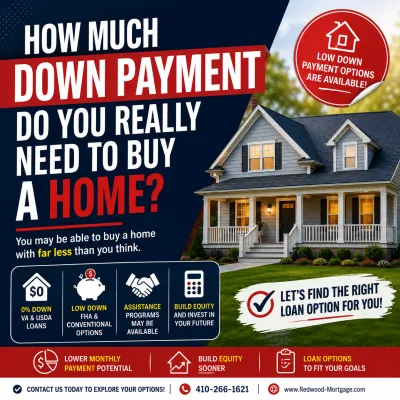
One of the biggest reasons people postpone buying a home is the belief that they need a large down payment. Many future homeowners spend years saving for 20%, only to discover later that they may have qualified much sooner.
The truth is that today's mortgage programs offer a variety of down payment options. Depending on the loan program and your qualifications, you may be able to purchase a home with far less than you expected.
Whether you're buying your first home in Annapolis, Anne Arundel County, or elsewhere in Maryland, Virginia, Washington, DC, Delaware, North Carolina, or Florida, understanding your options can help you make a confident plan and move forward at a pace that fits your budget.
If you're just beginning your homebuying journey, our First-Time Homebuyer Guide for 2026 walks you through every step of the process—from preparing your finances to closing on your new home.
What We Often See
One conversation we have with buyers almost every week is that many assume they need tens of thousands of dollars saved before they can even begin shopping for a home.
After reviewing their financing options, many are surprised to learn they may qualify with a much smaller down payment than they expected. Understanding your financing options early can help you create a realistic savings plan, compare loan programs, and determine whether you may already be closer to homeownership than you think.
Typical Minimum Down Payment Requirements*
| Loan Program | Typical Minimum Down Payment |
| Conventional | As low as 3% |
| FHA | As low as 3.5% |
| VA | 0% for eligible borrowers |
| USDA | 0% for eligible borrowers |
*Subject to qualification and program guidelines
Want to better understand how these loan programs compare? Our guide to USDA vs. FHA Loans: Which Mortgage Is Right for You? explains the differences in down payment, credit requirements, mortgage insurance, and eligibility.
The 20% Down Payment Myth
One of the most common homebuying misconceptions is that 20% down is required. In reality, many loan programs allow qualified buyers to put down much less. Some conventional loans may allow down payments as low as 3%, and some FHA loans allow low down payment options as well. Eligible VA and USDA borrowers may even qualify for no-down-payment programs.
That does not mean a smaller down payment is always the right choice. It simply means buyers often have more flexibility than they realize.
What a Larger Down Payment Can Do for You
Putting more money down upfront can still offer meaningful financial advantages. Depending on your loan program and qualifications, a larger down payment may help you:
- Lower your monthly mortgage payment
- Reduce the total interest paid over time
- Build equity in your home more quickly
- Possibly qualify for better loan terms
- Avoid private mortgage insurance in some situations
For some buyers, these benefits make a larger down payment worth the extra time spent saving.
Does Putting More Money Down Always Save You Money?
While a larger down payment often reduces your monthly payment and total interest costs, it isn't always the best financial decision.
Sometimes keeping additional savings for:
- emergencies
- repairs
- furniture
- reserves
may be the wiser choice.
How Much Cash Do You Need at Closing?
While the down payment gets most of the attention, it's equally important to understand your closing costs. Our guide, How Much Are Closing Costs When Buying a Home? , explains what buyers typically pay and how seller concessions may help reduce some of those expenses.
Your total cash needed at closing may also include:
- Closing costs
- Prepaid property taxes
- Homeowners insurance
- Earnest money deposits
- Moving expenses
- Initial home setup costs
Looking at the full "cash to close" amount—not just the down payment—can help you prepare more accurately for homeownership.
How to Decide on the Right Down Payment
The right down payment depends on your financial picture, your goals, and the type of home you want to buy. As you weigh your options, think about:
- Your monthly budget: A larger down payment can reduce monthly costs, but it should not leave you stretched too thin. If you're still determining what monthly payment fits comfortably within your budget, our article How Much House Can I Afford? explains the factors that influence your buying power.
- Your savings cushion: It is important to keep money set aside for emergencies, moving costs, and home maintenance.
- Your timeline: If waiting to save more would delay your plans significantly, a lower down payment option may help you buy sooner.
- Your long-term plans: If you expect to stay in the home for many years, a larger down payment may deliver stronger long-term value.
There is no one-size-fits-all answer. A smart down payment strategy balances homeownership goals with day-to-day financial stability.
Do Not Overlook Other Upfront Costs
Down payment planning is only part of the equation. Buyers should also prepare for other out-of-pocket costs, including closing costs, prepaid taxes and insurance, moving expenses, and initial home setup purchases. These expenses can add up quickly, so building them into your budget early can help prevent surprises.
Many buyers find it helpful to look at the full cash-to-close number rather than focusing on the down payment alone. Some of these costs may be reduced through seller concessions or other financing strategies, depending on your loan program and purchase agreement.
Ways to Boost Your Buying Power
If saving feels like the biggest obstacle, you may have more resources available than you think. Depending on your situation, options may include:
Down Payment Assistance
Some buyers may qualify for state, local, or employer-sponsored assistance programs that help reduce upfront costs.
Gift Funds
Many loan programs allow eligible gift funds from family members toward the down payment.
Seller Concessions
Depending on the purchase contract and loan program, seller concessions may help pay eligible closing costs.
Government-Backed Loans
VA and USDA loans may allow eligible borrowers to purchase with no down payment. Not sure which loan program fits your situation? Compare the benefits of FHA, USDA, VA, and Conventional financing in our USDA vs. FHA Loans: Which Mortgage Is Right for You? guide.
Exploring these opportunities may help you reach homeownership sooner while protecting more of your savings.
Should You Wait Until You Have 20% Down?
For some buyers, waiting to save a larger down payment makes financial sense.
For others, waiting may mean:
- paying rent longer
- missing opportunities to build equity
- purchasing later if home prices increase
The right answer depends on your financial goals, timeline, and comfort level—not an arbitrary percentage. Waiting to save a larger down payment isn't always the best financial decision. Our article Should I Buy a House Now or Wait for Rates to Drop? explores how timing, home prices, and mortgage rates can all affect affordability.
Build a Plan That Fits Your Goals
Every buyer's financial situation is different. Whether you're considering a low down payment loan, saving for a larger down payment, or simply trying to understand your options, Redwood Mortgage Services can help you compare real mortgage scenarios based on your goals and budget.
We'll explain the advantages and trade-offs of each approach so you can make an informed decision with confidence.
Contact Redwood Mortgage Services at 410-266-1621 to discuss your home financing options or begin your pre-approval today. Not sure whether you're ready to begin? Our article The Mortgage Mistake Costing Buyers Negotiating Power explains why getting pre-approved early can strengthen your position when you find the right home.
Written by Charles Stuart Kiehne, President of Redwood Mortgage Services.
Stuart has helped homebuyers and homeowners with mortgage financing solutions since 1999 and is licensed in Maryland, Virginia, Washington DC, Delaware, North Carolina, and Florida.
NMLS #92008
All loans subject to approval. Equal Housing Lender.
Frequently Asked Questions
Do I really need 20% down to buy a home?
No. Many buyers qualify with significantly smaller down payments depending on the loan program and their financial situation. Buyers are often surprised to learn there are several low-down-payment loan options available. Learn more in USDA vs. FHA Loans: Which Mortgage Is Right for You?
Can I buy a home with no money down?
Eligible VA and USDA borrowers may qualify for no-down-payment financing.
Is a larger down payment always better?
Not necessarily. While a larger down payment may reduce your monthly payment and total borrowing costs, it shouldn't leave you without sufficient emergency savings.
Can I use gift money for my down payment?
Many loan programs allow eligible gift funds from family members, subject to program requirements.
What is "cash to close"?
Cash to close generally includes your down payment, closing costs, prepaid taxes and insurance, and other settlement expenses.
Can seller concessions reduce my upfront costs?
Depending on the loan program and purchase agreement, seller concessions may help cover eligible closing costs.
Which loan requires the smallest down payment?
Eligible VA and USDA borrowers may qualify with no down payment, while FHA and certain conventional loans offer low down payment options.
Should I wait until I save 20%?
Not necessarily. Comparing your financing options with a mortgage professional can help determine whether buying sooner or waiting better supports your financial goals.
Related Reading
The First-Time Homebuyer Guide for 2026
Should I Buy a House Now or Wait for Rates to Drop?
USDA vs. FHA Loans: Which Mortgage Is Right for You?
How Much House Can I Afford?
How Much Are Closing Costs When Buying a Home?
The Mortgage Mistake Costing Buyers Negotiating Power
Should You Start with a Mortgage Lender or a Real Estate Agent?