
Construction-to-Permanent Loans in Maryland: How the Process Works
Published on Sep 18, 2026 | #RedwoodMortgageServices ConstructiontoPerm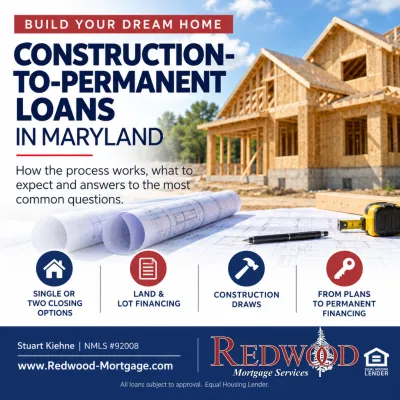
Building a home gives you the opportunity to create a property that fits your needs, but financing new construction works differently from getting a mortgage on an existing home.
Instead of purchasing a completed property with one mortgage closing, construction financing must account for the land, building plans, construction budget, builder, appraisal and the gradual release of funds as the home is built.
One option for Maryland homebuyers is a construction-to-permanent loan, which can combine construction financing and the permanent mortgage into a coordinated financing process.
If you're considering building a custom home in Annapolis, Anne Arundel County or elsewhere in Maryland, understanding how construction-to-permanent financing works before you sign a building contract can make the process much easier.
What Is a Construction-to-Permanent Loan?
A construction-to-permanent loan, sometimes called a C-to-P loan, provides financing for the construction of a new home and then transitions to permanent mortgage financing after construction is completed.
During construction, loan funds are generally released in stages, or draws, as work on the home progresses.
With a single-closing construction-to-permanent structure, the construction financing and permanent mortgage are closed together. Fannie Mae describes this type of transaction as one in which the borrower closes on both phases at the same time, with the construction loan automatically converting to the permanent mortgage after construction is completed.
This differs from a two-closing structure, where the construction financing and permanent mortgage involve separate transactions. Both types of construction-to-permanent financing exist.
How Does a Construction Loan Work in Maryland?
A traditional mortgage finances a home that already exists. With new construction, the finished home hasn't been built yet.
That changes the lending process.
Before construction begins, the lender may need to evaluate information such as the proposed building plans and specifications, construction contract and budget, builder information, land or lot, borrower qualifications and the expected completed value of the home.
An appraisal is typically based on the plans and specifications and considers the property's anticipated value when construction is complete.
Rather than providing all construction funds at once, funds are generally disbursed as construction progresses. CFPB notes that construction-loan funds are typically provided through a series of advances during construction.
That brings us to one of the biggest differences between construction financing and an ordinary mortgage: the draw process.
What Is a Construction Draw?
A construction draw is a release of a portion of the construction loan funds to pay for completed or eligible construction work.
Instead of handing the builder the entire construction budget at closing, funds are generally released at different stages of the project.
Depending on the loan and construction plan, draws might correspond with milestones such as site work and foundation, framing, mechanical systems, drywall and interior work, and final completion.
Inspections or other documentation may be required before a draw is released to verify the progress of construction.
With Fannie Mae single-closing construction-to-permanent financing, the lender is responsible for managing disbursement of construction proceeds to the builder, contractor or other authorized suppliers.
What Is the Difference Between a One-Time Close and a Two-Time Close?
This is one of the most important concepts for someone comparing construction loan options.
Single-Closing Construction-to-Permanent Loan
With a single-closing structure, the construction financing and permanent financing are arranged in one transaction.
The borrower closes before construction begins, funds are advanced during the building process, and after the home is completed and applicable requirements are satisfied, the loan transitions into its permanent mortgage phase.
Fannie Mae describes single-closing C-to-P financing as allowing the lender to underwrite and close the construction loan and permanent financing at the same time using one set of closing documents.
Two-Closing Construction Financing
With a two-closing structure, the borrower generally obtains construction financing first and permanent mortgage financing separately.
That can mean another financing transaction after construction is completed.
Freddie Mac notes that separate construction and permanent financing can result in two sets of closing costs.
Neither structure should automatically be considered right for every borrower. The available loan programs, project, financial qualifications, timeline and long-term goals all matter.
What If I Already Own the Land?
Owning the building lot before applying for construction financing does not necessarily prevent you from using construction-to-permanent financing.
Depending on the loan program and transaction structure, the value or equity in land you already own may be considered as part of the financing.
For example, Fannie Mae's current single-closing guidance distinguishes between transactions where the borrower is acquiring the lot as part of the transaction and those where the borrower already holds title to the lot.
The treatment of the land, existing liens and equity depends on the specific loan program and circumstances, so this is an excellent issue to discuss with a mortgage professional before construction begins.
Can I Finance the Land and Construction Together?
Depending on the construction loan program, financing may be available for both the acquisition of the lot and construction of the home.
For certain Fannie Mae single-closing purchase transactions, for example, the borrower may use the construction-to-permanent financing to purchase the lot and finance construction.
That doesn't mean every construction loan works this way. Program requirements vary, making it important to determine how the land will be handled before finalizing the purchase or construction contract.
How Is a Home Appraised Before It Is Built?
This is one of the questions that surprises many future custom-home owners.
The lender doesn't necessarily have to wait until the house exists to establish an expected property value.
For construction financing, the appraisal can consider the plans, specifications, proposed improvements, lot and other information to determine the property's anticipated as-completed value.
Fannie Mae's current single-closing guidance specifically uses the “as completed” appraised value in its loan-to-value calculations.
Once construction is finished, the lender may require documentation or inspection confirming that the home has been completed in accordance with applicable requirements.
What Does a Construction Lender Review?
Construction financing involves more than determining whether the borrower qualifies for a mortgage.
The lender also needs to understand the project being financed.
Depending on the program, that review may include the borrower and financial documentation, land ownership or purchase, builder, construction contract, plans and specifications, project budget, construction timeline, appraisal and required reserves or funds.
Requirements vary considerably among construction loan programs.
That's one reason we recommend discussing financing before making major commitments to a lot, builder or construction contract whenever possible.
Do You Make Mortgage Payments While the Home Is Being Built?
Payment requirements during construction depend on the particular construction loan.
Construction loans typically involve multiple advances rather than the entire construction amount being disbursed at once. CFPB notes that construction-loan funds are usually advanced as construction progresses.
Depending on the program, payments during construction may be based on amounts that have actually been advanced rather than the entire eventual loan amount.
Your lender should explain exactly how payments are calculated, when they begin and what happens when the loan transitions to permanent financing.
What Happens When Construction Is Finished?
With a single-closing construction-to-permanent loan, completion of the home moves the financing from its construction phase into its permanent mortgage phase, subject to the requirements of the particular loan.
This is one of the defining features of the single-close structure: the permanent financing has already been incorporated into the transaction rather than requiring the borrower to begin an entirely separate mortgage process after the house is built.
Final inspections, completion documentation and other requirements may need to be satisfied before conversion.
Once the loan enters its permanent phase, it functions as long-term mortgage financing according to its final terms.
When Should I Talk to a Lender About a Construction Loan?
Earlier than many people think.
If you're seriously considering building a home, it can be helpful to discuss financing before you finalize the lot purchase, sign a construction contract or make significant nonrefundable commitments.
An early conversation can help you understand how much you may qualify to finance, how land ownership could affect the transaction, what the lender will need from your builder, how the construction budget will be evaluated, what funds you may need, and which construction financing structures may be available.
A beautiful set of plans doesn't automatically mean the project fits the financing.
Understanding both sides before construction begins can prevent surprises later.
Building a Home in Maryland?
Construction financing has more moving parts than financing an existing home, but those pieces become much easier to understand when they're addressed before the project begins.
Redwood Mortgage Services helps borrowers explore construction-to-permanent financing for custom homes and residential construction projects throughout Maryland.
Whether you're still considering a homesite, already own your land or have begun working with a builder, we can help you understand how the financing may fit into your overall construction plan.
Learn more about [Construction Loans in Maryland] on our Construction Loan Program page, or schedule a consultation to discuss your project.
Frequently Asked Questions
What is a construction-to-permanent loan?
A construction-to-permanent loan provides financing during construction and then transitions to long-term mortgage financing after the home is completed. Depending on the program, this may be structured with one closing or separate construction and permanent-financing transactions.
Can I use a construction loan if I already own my land?
Potentially. Construction-to-permanent financing can accommodate situations in which the borrower already owns the lot, although the treatment of land value, equity and existing liens depends on the loan program and transaction.
Can the construction loan include the purchase of the lot?
Some construction-to-permanent programs can finance both the lot purchase and construction. Eligibility and the way the transaction is structured depend on the particular loan program.
How does the builder get paid during construction?
Construction funds are generally released in stages as work progresses. The lender manages the draw process according to the construction loan requirements, and inspections or other documentation may be required before funds are released.
Do I need a builder before applying for a construction loan?
You can discuss financing before selecting your final builder, and doing so may be useful. Before the construction loan can proceed to closing, however, the lender will generally need detailed information about the project and builder in accordance with the particular loan program.
Is a construction-to-permanent loan the same as a regular mortgage?
No. Construction financing involves funding a home while it is being built, generally through staged advances. Construction-to-permanent financing then transitions into long-term mortgage financing after construction is completed.
Is a single-close construction loan better than a two-close loan?
Not necessarily. Each structure works differently, and the appropriate option depends on the available programs, project, borrower qualifications, costs and financing goals. Fannie Mae and Freddie Mac both recognize single- and two-closing construction-to-permanent structures.
Related Reading
Construction Loans in Maryland
Explore Redwood Mortgage Services' construction-to-permanent financing options for borrowers planning to build a home in Maryland.
How Much Down Payment Do You Really Need to Buy a Home?
Learn how down payment requirements can vary by loan program and why the amount you need may be different from what you expect.
How Much Cash Do You Really Need to Buy a Home?
A down payment isn't the only expense to consider. Learn about some of the costs buyers may need to plan for when financing a home.
Have Questions About Construction Financing?
Building a home involves more moving parts than purchasing an existing property. Stuart Kiehne can help you understand how construction-to-permanent financing may fit your plans before you commit to a lot, builder or construction contract.
Stuart Kiehne | President
NMLS #92008
Redwood Mortgage Services
410-266-1641
www.Redwood-Mortgage.com